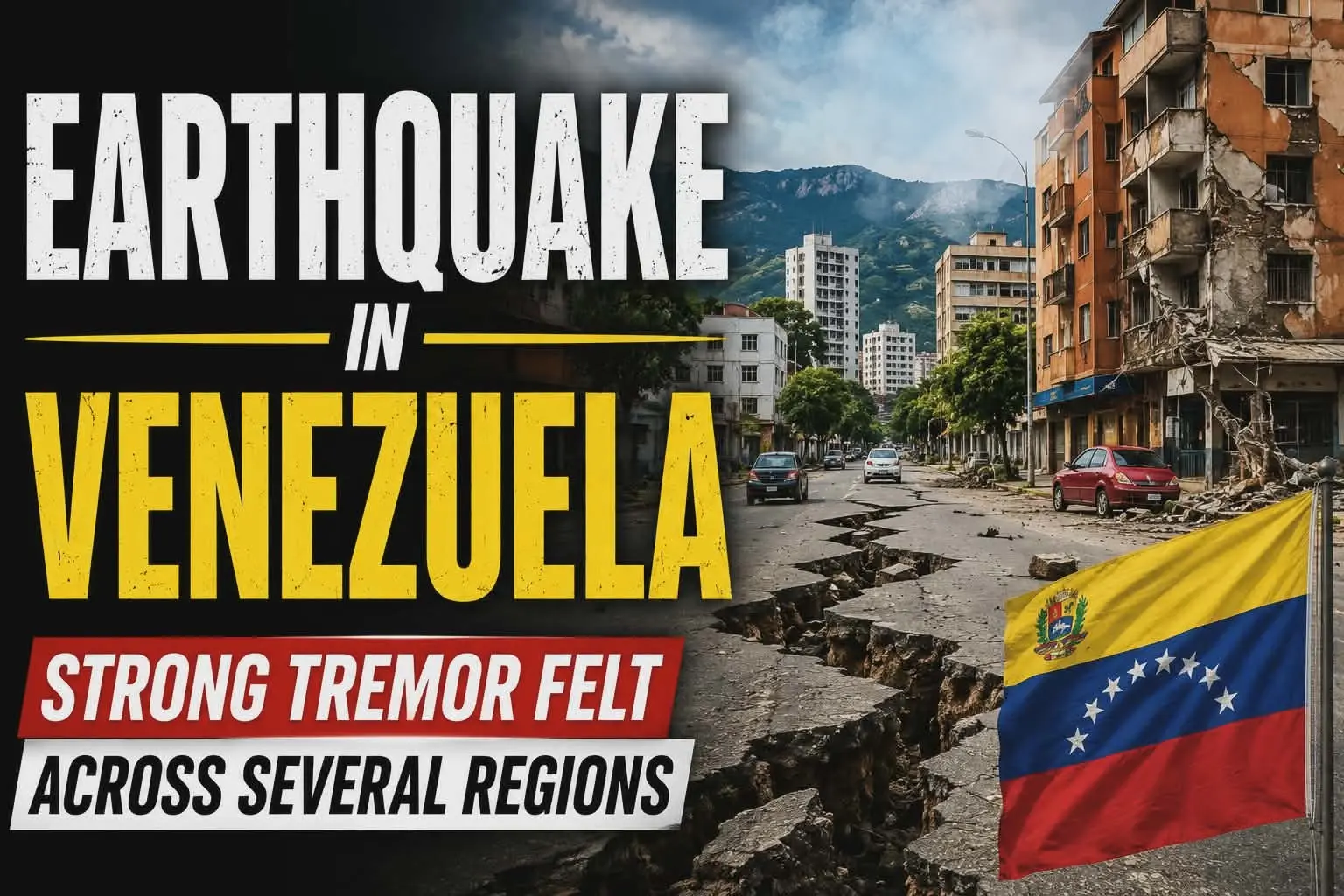
Venezuela Earthquake Devastates
CARACAS — A catastrophic sequence of earthquakes leveled parts of north-central Venezuela on Wednesday, June 24, 2026. Striking less than a minute apart, the massive tremors have triggered a severe humanitarian emergency. According to the United Nations, authorities confirm that at least 1,430 people have lost their lives, a figure that is tragically expected to grow as rescue workers sift through the rubble.
Unprecedented Seismic Event
The disaster commenced around 6:04 PM local time when a magnitude 7.2 foreshock hit near San Felipe in Yaracuy state. Only 39 seconds later, an even more powerful 7.5 magnitude mainshock ruptured along the San Sebastián fault system.
Based on data from the U.S. Geological Survey (USGS), the violent tremors radiated outward, dealing severe blows to the capital city of Caracas and the coastal state of La Guaira. Seismologists describe this rare “doublet” event as the most destructive geological disaster the nation has witnessed in over a century.
Widespread Carnage and Disruption
The human cost has been staggering. Current UN estimates indicate that medical facilities are treating upwards of 3,200 injured individuals, while over 68,000 people remain missing.
Coastal communities such as Caraballeda and Macuto bore the brunt of the devastation. High-rise apartments and oceanfront resorts collapsed, burying residents under tons of concrete. Crucial infrastructure—including hospitals, schools, and transit networks—has been heavily compromised. International airports have suspended operations, and widespread power blackouts continue to hamper recovery efforts across affected states.
Closing of the Survival Window
Time is rapidly running out for those still trapped beneath the debris. Sunday marks the grim passing of the 72-hour survival window—the critical timeframe that disaster experts say offers the highest probability of finding survivors before the chances of survival drop significantly.
A coordinated international response, spearheaded by the UN Office for the Coordination of Humanitarian Affairs (OCHA), has brought in over 2,200 urban search-and-rescue experts and 140 sniffer dogs from 27 different nations. However, these dedicated teams face daunting challenges, navigating severed communication lines and enduring more than 300 aftershocks that threaten to bring down already unstable structures.
A Massive Economic Toll
The financial ramifications of the disaster are similarly immense. The United Nations Development Programme (UNDP) estimates immediate physical damages to be roughly $6.7 billion, representing approximately 6% of the country’s gross domestic product. Total economic losses are projected to climb even higher as full assessments are completed.
As search operations persist, global aid groups are rushing to deliver emergency medical supplies, safe drinking water, and temporary housing to support the roughly 2.1 million citizens directly impacted by this unprecedented catastrophe.